Iridomyrmex purpureus holds its place within the Hymenoptera order, Formicidae family, Dolichoderinae subfamily, Leptomyrmecini tribe, and Iridomyrmex genus. At the pinnacle of its taxonomic hierarchy, it is identified by the specific binomial name Iridomyrmex purpureus, as bestowed by the taxonomist Smith in 1858.
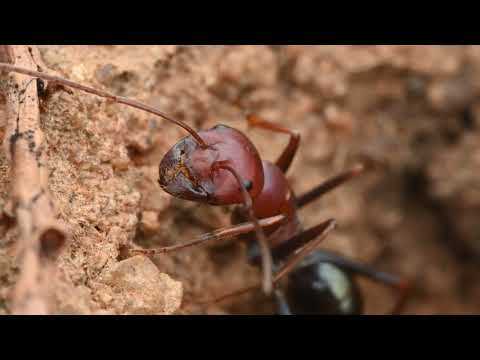
This fascinating species distinguishes itself through the construction of expansive gravel mounds, punctuated by multiple nest holes. Characterized by an unwavering pugnacity, the workers of Iridomyrmex purpureus stand ready to assail any intruder or creature that disrupts the sanctity of their nesting grounds. Their foraging activities encompass the ground below and the heights of trees, a relentless pursuit in search of nectar and honeydew. These ants have ritualised fights to protect resources near their nest, when they face other colonies of the sames species (see video below):
Identification:
The discerning eye may find the identification of workers to be a challenging endeavor, as they bear a striking resemblance to their counterparts in the Iridomyrmex lividus species. Embracing polymorphism, I. purpureus manifests variations in color, setae, and iridescence. Notably, the erect setae on the genae present a spectrum of diversity among different populations.
Distribution:
This species finds its habitat in the expansive and diverse landscapes of Australia. Its distribution sprawls from the extreme southern coast of Western Australia to the arid regions of the southwest, marking its presence in a range as vast and varied as the continent itself.
Biology:
Iridomyrmex purpureus stands as a polygynous species, with the complex social structure involving multiple queens. The diligent workers of this species exhibit a curious behavior of collecting fresh bat guano, transporting it back to their nests, where it serves as a valuable high-nitrate food source. Interactions with other species add another layer to its biological narrative, with instances of robbing by Chestnut-rumped Thornbills.
The establishment of new colonies follows the solitary endeavors of single queens after their nuptial flight in October. Some queens find protection within mature colonies, and the dynamics of queen numbers witness the influence of foundress association and tolerance.
Life History Traits:
Delving into the life history traits of Iridomyrmex purpureus reveals a polygynous structure, where multiple queens coexist within a single colony. The queens, distinguishable by their winged form, engage in the intriguing phenomenon of queenless worker reproduction. Mating occurs with a frequency of a singular event per queen during the nuptial flight, marking a crucial stage in the perpetuation of this remarkable species.
More info on their biology can be found on AntWiki.



No comments:
Post a Comment