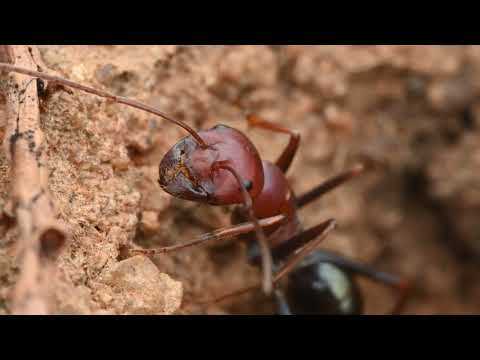
Lasius fuliginosus, commonly known as the jet ant or jet black ant, is a species belonging to the subfamily Formicinae.
Distribution
This ant species is widespread across Europe and Asia, inhabiting regions from Portugal and Ireland to Finland in the north, Italy in the south, and extending eastwards to Korea and Japan. In the UK, it is primarily found south of The Wash, in East Anglia, Southern England, and occasionally in Ireland.
Morphology
Workers of Lasius fuliginosus boast a distinctive black shiny color, a relatively large head with rounded occipital lobes, and brownish-yellow legs. Queens, larger than workers, share the black shiny color but possess a heart-shaped head and more abundant body hairs. Males, with suberect hairs, are smaller in size.
Behavior of Lasius fuliginosus
To convey alarm, these ants dispense dendrolasin, a terpenoid compound, from their mandibular glands. They form a fascinating association with the nitidulid beetle Amphotis marginata, known as the "highwayman." These beetles exploit ants returning to the nest by tricking them into regurgitating food, engaging in a clever tactic known as trophallaxis.
Habitat
Lasius fuliginosus constructs unique "cardboard" nests in old hollow trees using a mixture of chewed wood and saliva, resembling the habits of termites. A single nest houses one queen, but larger colonies can include up to 15,000 workers. These ants tend aphids for honeydew and establish large scent trails for efficient foraging, clearing paths for months.
Reproduction and parasitic foundation
Unlike some black ant species, Lasius fuliginosus employs social parasitism for reproduction. The post-nuptial queen invades nests of another ant species, Lasius umbratus, kills or ousts the existing queen, lays eggs tended by the host workers, and gradually takes over the nest.



No comments:
Post a Comment